

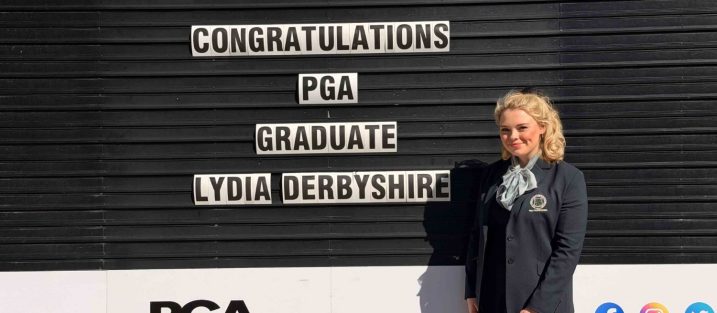
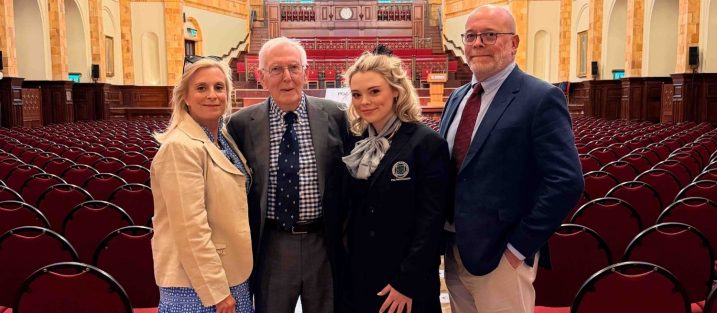
Knaresborough-based PGA professional Lydia Derbyshire was presented with a £1,000 award from PING for her “remarkable strength and inspiring dedication throughout the PGA training programme” as she completed her foundation degree and graduated.
Lydia, who began her training three years ago, was competing in a pro am at Knaresborough when the discomfort in her back – an ache that had dogged her for years – became unbearable.
“I couldn’t feel anything down my left leg,” said the 25-year-old in an interview with The PGA. “I couldn’t bend down. I couldn’t move. I was in absolute agony.”
Chiropractors and GPs told her it was muscular, though she’d been seeing physios for years and still wasn’t getting any better. She couldn’t swing a club without anguish, and for someone who loved demonstrating shots to her students, it was debilitating.
“The effect that had on me mentally was shocking,” added Lydia. “I couldn’t play. I couldn’t do what I loved.”
Lydia finally saw a surgeon and was diagnosed with moderate to severe scoliosis. The curvature was significant at both the top and bottom of her spine, while Arthritis and a slipped disc were also diagnosed.
“The surgeon showed me the X-ray and said, ‘I don’t know if you can play anymore’. That broke me completely.”
Lydia’s entire life had revolved around golf. She’d picked up the game as a three-year-old when her grandfather handed her a set of plastic clubs. She’d gone on to play junior golf for her county and when it came to choosing between university and golf, there was only one winner.
“It got to the point where I sat down with my parents and said ‘I don’t want to go to university. I want to do golf’.” She quit her A-Levels and went to work at Alwoodley. Spells at Rudding Park and Ilkley followed before she joined the team at Knaresborough.
Lydia enrolled on the Foundation Degree in Professional Golf Studies while at Ilkley – a three-year distance learning programme which sees students also work in the golf industry. She joined in the wake of the first Covid lockdown, but injuries disrupted her progress. Despite that, she was certain coaching was where she belonged.
“I love talking to people. I love meeting new people,” she said. “The amount of theory to learn about teaching is incredible too. Club fitting was much more in depth than I imagined it to be; it’s very technical and complicated. It’s a challenge.”
When she received her scoliosis diagnosis, the emotional impact was immediate. She feared not just that her playing days might be over, but that her entire future in golf may be under threat.
“I couldn’t go to work, and I felt like I didn’t know what I was going to do because I wouldn’t be able to do my job anymore. That was heartbreaking. I’d put all this time and effort into doing my course – the exams, the essays, the learning – and I thought it was all going to be taken away from me in a split second over something I couldn’t control.”
Instead, the experience has reshaped her coaching and her understanding of what a career in golf can look like.
“When I told The PGA, they were so supportive,” Lydia said. “It was a lot of hand-holding for me. They were just great.
“I’d send them notes from the surgeon and doctors, and X-rays, and they were really supportive and said I could still do my course and be able to coach. I’d just not be able to play.”
“I had this lifeline given to me – ‘you can still do your job’ – even though I’m not able to play at the moment.”
Before her diagnosis, Lydia would demonstrate heavily during lessons. She would take clubs out with her during a playing lesson and hit shots, showing positions and movements through her own swing. Now she coaches differently.
“Looking back on it now, I don’t know how helpful that was for a lot of my clients,” she said. “The average golfer can’t [see differences in swings], so I found not being able to demonstrate didn’t massively affect the outcomes of my lessons.
“What I do now is put my clients into the positions I want them to get in. It’s a lot of manoeuvring and adjusting. I take a lot of videos now too.
“I’ve learned to adapt the way I teach and I’m approaching it with greater empathy. It’s made me much more aware, if people have mobility issues or a physical disability, of how to manage that. It has already made me a better coach.”
Whether she will play again is still uncertain and Lydia may eventually need spinal fusion surgery, and she continues to require physiotherapy and injections to manage her condition.
“I do believe I could get back playing, but I don’t know if I’ll ever get around 18 holes again,” she said.
Though expectations have changed, her enthusiasm for the game remains undiminished.
“If I’d gone down a different avenue, I wouldn’t have golf in my life anymore,” she said. “Before I was coaching, I was playing and that’s been taken away from me, but the foundation degree has given me that lifeline to be able to teach, to still do what I love, and to help people.
“Golf clubs are progressing so quickly too. For a golf club to have a female professional is fantastic. There should be more of us – I noticed in graduation there wasn’t many – and it would be great if in 10 years’ time that instead of being a handful there was 20-30 girls graduating.”
For now, Lydia’s focus is on coaching and continuing to build her career at Knaresborough.
“The ideal situation would be running my own coaching business, having an academy of my own at a driving range would be awesome, and being able to teach my methods.”
Following her graduation, Lydia thanked Knaresborough pro Gareth Murray for his support, and she plans to continue her education with a BSc starting in September.

